
When something starts feeling off with IT, the typical response is to look for technology to fix it. Better tools, better support contract, faster response times from whoever handles the helpdesk. That makes sense on the surface – something feels broken, so you upgrade something to fix it.
But I’ve found that in most growing businesses, that instinct points you in the wrong direction. The problem usually isn’t the tools you have or the support you’re getting. The problem is that nobody can give you a clear picture of how everything actually fits together or what your business depends on to operate.
I work with small businesses that have been running successfully for years. Good companies with smart owners and employees who care about doing things right. And almost every one of them struggles with the same basic issue.
Nobody can confidently answer fundamental operational questions.
Who currently has access to what systems? Not who should have access based on their role, but who can actually log in right now. What would stop working if this particular server went down tomorrow? Are we still paying for software subscriptions that people stopped using a year or two ago? When that employee left last spring, did we properly close out all their access – not just email, but vendor portals, file shares, admin rights to various tools?
These aren’t complicated technical questions. They’re basic operational fundamentals that matter every time someone joins the company, leaves the company, or needs their access changed. But in a growing business without dedicated IT leadership, nobody clearly owns these questions. They fall into the gap between the people running the business day-to-day and whoever handles IT when something breaks.
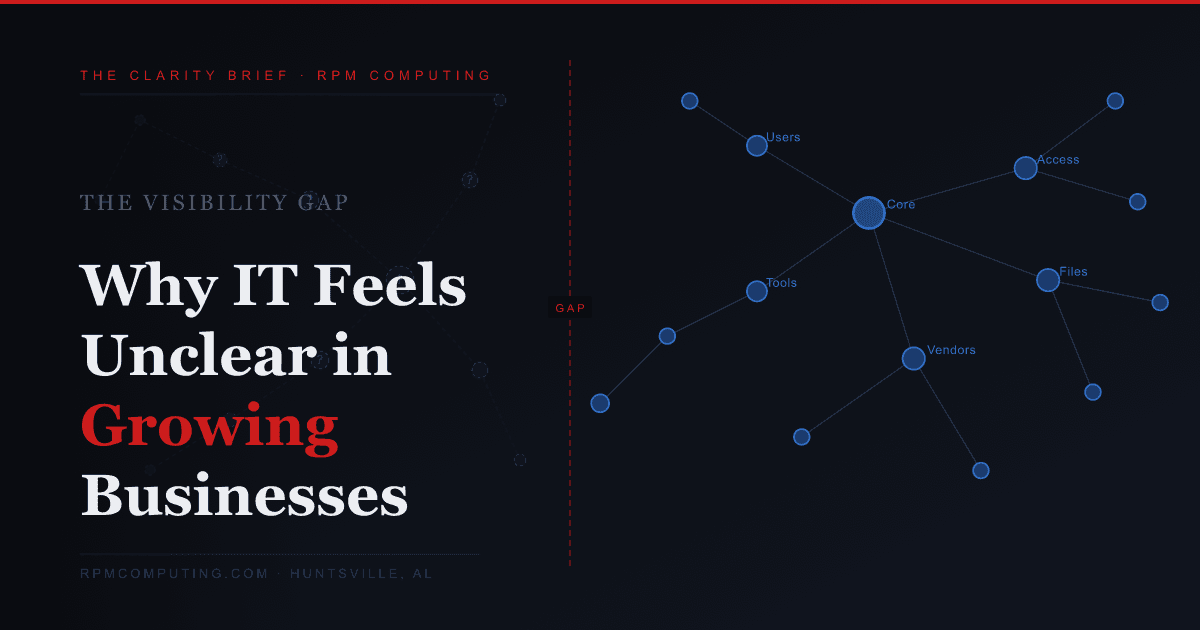
That gap – the space where nobody’s responsible for keeping the full picture clear – is what causes most of the problems I see. And it’s far more common than most business owners realize until something forces it to become visible.
This isn’t carelessness or poor management. It’s just what happens when businesses grow past a certain size.
When you’re running a business with five employees, the owner typically knows everything. Five people, one location, maybe a dozen systems and tools total. That all fits in someone’s head reasonably well. Changes happen slowly enough that you can keep track mentally.
Then you start growing. You add employees, each of whom needs access to multiple systems. You add tools to solve immediate problems – someone needs project management software, someone else needs a better way to share files, another department needs their own specialized application. You add vendors who need access to certain systems or data. All of these decisions get made quickly because you’re busy running the business and solving problems as they come up.
Nobody sits down to document these changes in detail because documentation feels like overhead when you’re moving fast and there are more urgent priorities. One day you’re at eighteen or twenty employees and you realize that nobody can answer those basic questions anymore. The picture got too large and too complex to track reliably in anyone’s head, but nothing flagged that transition. Systems kept running, work kept getting done, so there was no clear signal that the informal approach had stopped being adequate.
Meanwhile, risk has been building quietly in the background.
This is where I see businesses make expensive mistakes that don’t actually solve the underlying problem.
They feel the friction – things taking longer than they should, uncertainty about whether they’re protected, a general sense that IT is becoming messy or complicated. So they respond by adding technology. A new security tool, a new backup system, an upgraded IT support contract with better response times.
Those additions might have value on their own. But they don’t solve what I’d call a clarity problem. They add more complexity and more moving parts to a picture that was already unclear. Now you have more systems to track, more vendors to coordinate with, more subscriptions to manage, more access points to control.
What actually solves this kind of problem is having someone whose job is to understand how your business operates, what it depends on, and to keep that picture clear over time as things change. That’s not primarily a technical role, even though it requires technical knowledge. It’s a leadership role – someone thinking about IT from the business level, not just the help desk level.
That’s the difference between having someone who fixes problems when they come up and having someone who prevents problems by maintaining clarity about what you have and where the gaps are.
When I start working with a new business, I’m not immediately diving into hardware specifications or comparing software versions. That comes later, once we know what we’re actually trying to protect and improve.
The first questions I ask are business questions with technical implications.
What does this business actually depend on to operate every day? Not just in general terms, but at the system level – which specific tools, connections, processes, and access points have to be working for the business to function normally.
Where are the single points of failure or concentration of risk? The critical process that runs through one person’s laptop. The vendor who has more access than anyone remembered. The system that everyone depends on but nobody has tested recovering from a backup.
Who has access to what right now, and does that still make sense based on current roles and responsibilities? Not just whether access was set up correctly when someone started, but whether it’s been updated as people changed positions or left the company.
What decisions keep getting deferred because nobody clearly owns them? The server that should probably be upgraded. The tools that should be consolidated. The security practices that should be standardized. These stay on the list because nothing has forced them to the top yet, but they’re creating exposure that grows over time.
That process of mapping what the business actually depends on and where the gaps are is what creates the clarity that makes everything else easier. Once you have that picture, the technology decisions become more straightforward. You know what to protect because you know what matters most. You know what to invest in because you can see where the real risks are. You know what to fix first because you understand the actual consequences of things breaking.
Without that foundational clarity, you’re essentially making IT decisions by guessing at implications and hoping you’re protecting the right things.
If you’re reading this and recognizing these patterns in your own business, you’re not behind or doing something wrong. You’re just at the stage where the informal approach to IT that worked fine at five or ten employees stops being adequate.
The transition from informal to structured IT management doesn’t require months of disruption or a massive technology overhaul. A structured advisory engagement can surface the most important gaps and give you a clear picture of your current state in a matter of weeks, without disrupting daily operations and without committing to a long-term managed services contract.
What I do in that kind of engagement is map what you currently have, identify where the meaningful risks are based on how your business actually operates, and help you prioritize what needs to change based on impact and urgency. From there you can decide how to address it – whether that’s implementing changes yourself, working with someone on an ongoing basis, or something in between.
But you can’t make informed decisions about next steps until you know where you actually stand right now. That clarity is the foundation everything else builds on.
If you want to know what that process would look like for your business, that’s worth a conversation. No pitch, no pressure – just a straightforward discussion about what you’re seeing and whether it’s something I can help with.
